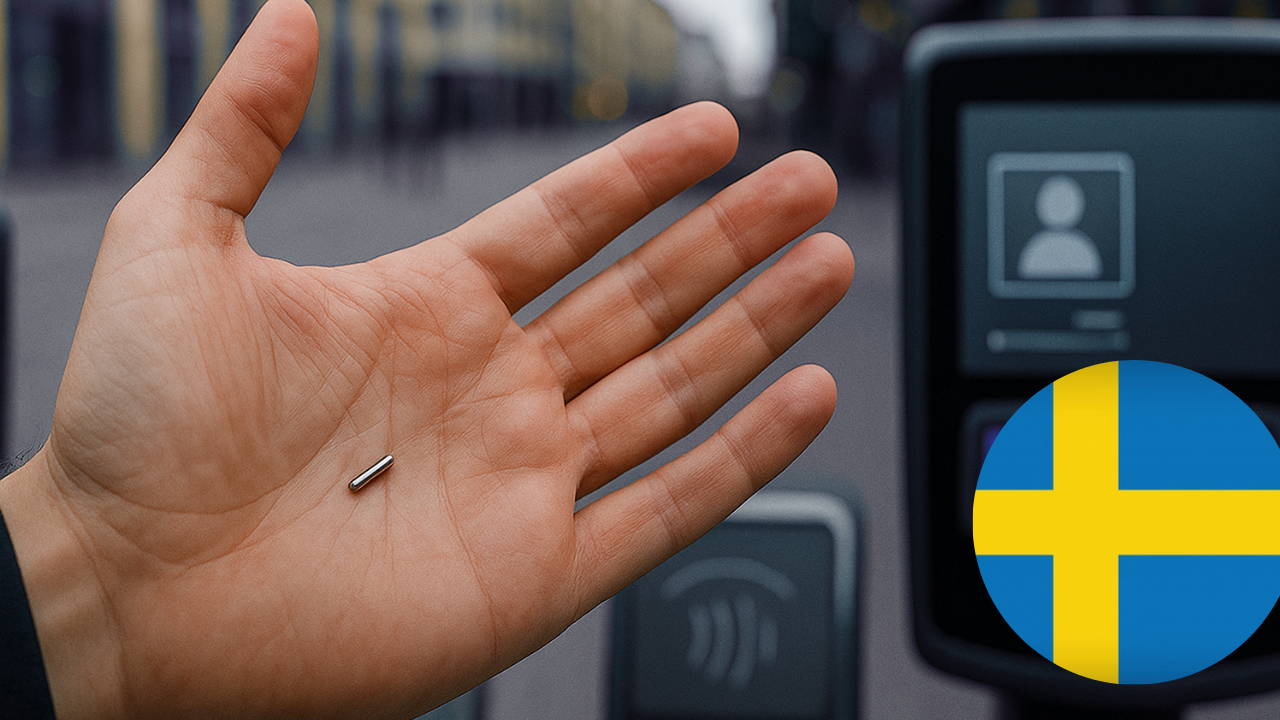

Sweden has quietly become one of the world’s most advanced testing grounds for implantable identification technology. More than 6,000 people around the world — with the majority in Sweden according to industry figures — have adopted tiny NFC/RFID microchips beneath the skin for tasks such as opening doors, making small payments and replacing access cards. SAGE Journals
What is an NFC microchip implant and how does it work?
NFC (Near Field Communication) microchip implants are passive, rice-sized devices inserted beneath the skin (commonly between the thumb and index finger). When the implanted chip is brought near a reader, it transmits a short-range identifier that a compatible reader can verify. The chips do not have a battery; they draw power from the reader’s electromagnetic field, and the identifier is then mapped by a back-end system to a user’s account, access permissions or other credentials. Los Angeles Times+1
Why are people getting implanted?
Motivations are practical and varied:
- Convenience: no need to carry cards, keys or tickets for everyday errands and office access.
- Durability: implants don’t get lost and are typically waterproof.
- Curiosity and early adoption: many adopters are biohackers or tech enthusiasts.
- Workplace pilots: some companies have offered voluntary implants to employees to streamline office access and services. Notably, the Epicenter tech hub in Stockholm offered implants to staff (about 150 employees) beginning in 2015 — one of the better-known early workplace pilots. World Economic Forum+1

What researchers are studying
Academics and social scientists are studying Sweden as a real-world example of human-technology integration. Lund University and other researchers have documented the phenomenon and examined cultural, ethical and social drivers behind uptake, producing materials that analyze how Swedish trust in digital systems has shaped adoption. Lund University
Benefits and real-world use cases
When deployed in controlled settings, implantable NFC IDs show clear advantages:
- Access control: secure entry to offices, gyms, co-working spaces and equipment.
- Micro-payments: pilots have demonstrated contactless payment for small transactions inside controlled ecosystems.
- Streamlined transit or membership verification: some early experiments have linked transit or rail passes to implant IDs. World Economic Forum
Privacy, security and ethical concerns
Experts warn the same features that make implants convenient also raise risks:
- Privacy: implants broadcast an identifier that can be read by nearby readers; without strict governance, that identifier could be correlated to movement and behavior.
- Data security: the mapping between chip IDs and personal accounts must be protected to avoid identity exposure.
- Function creep and surveillance: implants intended for convenience could be repurposed for location tracking, workplace surveillance, or other uses without fully informed consent.
- Policy gaps: commentators and policy analysts point to the need for legal safeguards to prevent coercion and to ensure voluntary adoption remains meaningful. CSIS+1
Technical and regulatory best practices
To reduce harm and protect users, organizations should follow privacy-first practices:
- Keep only a randomized identifier on the implant and store sensitive records separately.
- Require multi-factor authentication for high-risk actions.
- Maintain encrypted back-end systems and strict access auditing.
- Obtain clear, documented informed consent and provide removal/opt-out pathways.
- Allow independent audits and publish transparency reports. These are consistent recommendations from privacy researchers and legal scholars studying implant use. Iowa Law Review+1

Public attitudes and the future
Public reaction is mixed: tech communities tend to be more enthusiastic, while broader publics express caution about privacy and bodily autonomy. Sweden’s pilots — and the academic work documenting them — offer a testbed that other countries and companies will likely study before moving forward. If regulators and employers prioritize consent, minimal data practices and strong legal protections, implants could deliver niche convenience without eroding rights; if they do not, implants risk enabling new forms of surveillance. Lund University+1
Conclusion
Sweden’s microchip experiments ask a basic question: can embedding contactless identity tools under the skin produce net societal benefit? The answer depends less on the hardware and more on governance: robust safeguards, transparent consent, strong data security and independent oversight will determine whether this technology becomes a responsible convenience or a cautionary tale.
External sources and further reading
(Click the titles to read the original reporting or studies.)
- Lund University — The Swedish Microchipping Phenomenon (Lund University publication). Lund University
- Rothschild, Chipping away at our privacy (SAGE / discussion of Biohax and adoption figures). SAGE Journals
- World Economic Forum — Microchip in your hand: the Epicenter story (background on Epicenter and Biohax). World Economic Forum
- Los Angeles Times — Companies start implanting microchips into workers’ bodies (reporting on early workplace pilots). Los Angeles Times
- CSIS — Fear, uncertainty and doubt about human microchips (policy perspective on security and governance). CSIS

 By
By


 注册免费账户 says: