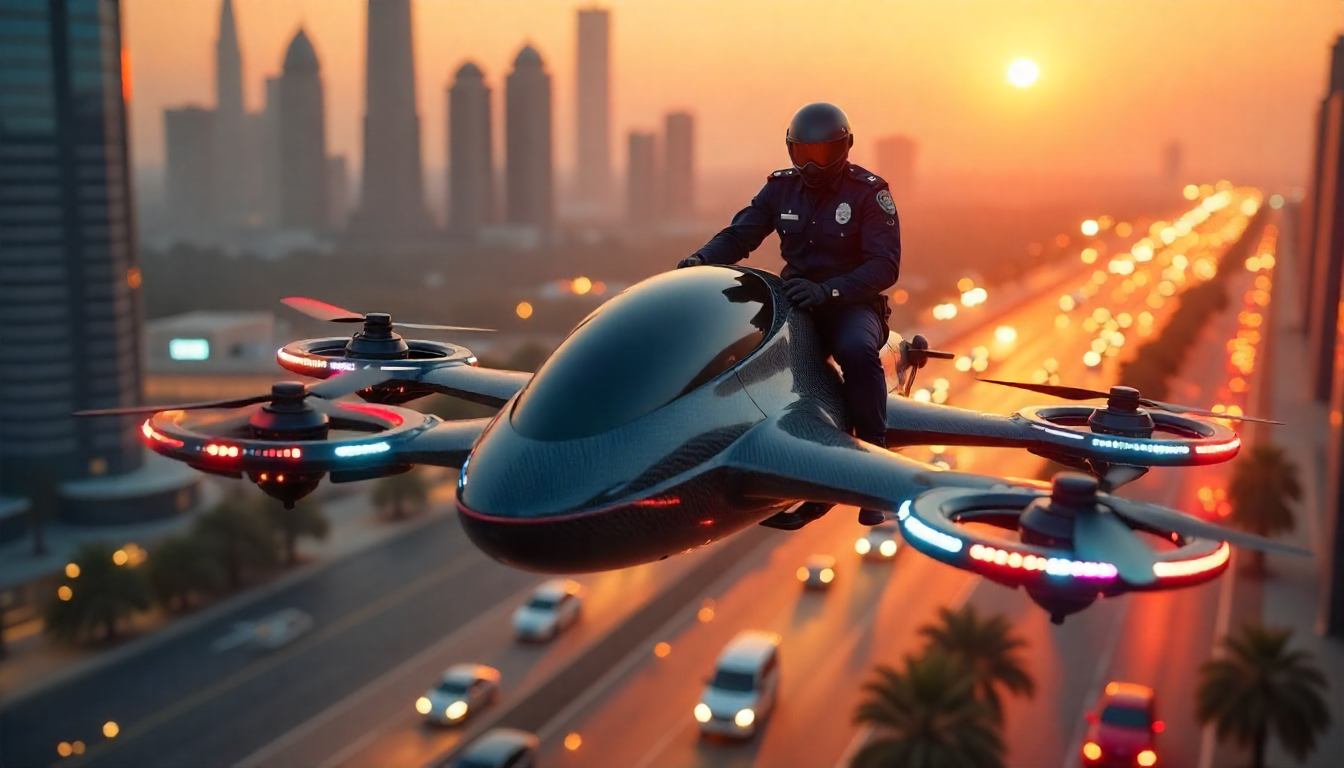

Dubai has always been a city that embraces futuristic innovation, from driverless metro systems to robotic police officers. Now, the city is making headlines once again with its latest experiment: drone-like hoverbikes designed for law enforcement. This bold step highlights Dubai’s determination to stay ahead in the race for smart policing technologies.

The Concept: Flying Patrol Units
The core idea behind the hoverbike project is simple yet revolutionary — create a vehicle that can bypass congested traffic and access locations where traditional police cars or bikes cannot. The compact, quadrotor-powered bikes are capable of vertical takeoff and landing, making them well-suited for emergencies in crowded urban areas.
According to Gulf News, Dubai Police see this as part of their long-term vision to incorporate advanced aerial mobility into daily security operations.
Demonstrations and Early Trials
During demonstrations, the hoverbikes impressed spectators with their quick takeoffs, stable hovering, and smooth landings. These features make them particularly useful for crowd monitoring, rapid response to accidents, and surveillance in areas difficult to reach with ground patrols.
The trial runs are part of Dubai’s broader mission to integrate innovative technologies into city services, a move supported by global initiatives in urban air mobility such as those studied by Urban Air Mobility News.
How the Hoverbikes Work
The bikes are built with lightweight carbon-fiber frames, powerful quadrotor propellers, and advanced flight software to maintain stability even in windy conditions. They are also fitted with strobe lights for visibility and a geo-fencing system that ensures safe flight boundaries.
For more on aerial vehicle development, check out NASA’s Advanced Air Mobility Program which explores similar concepts for future cities.
Training and Safety
Dubai Police officers undergo rigorous training to operate these hoverbikes, focusing on short, controlled flights due to the current limitation of battery life. Safety has been a top priority during trials, with features such as emergency cutoffs, throttle limits, and spectator safety buffers all in place.
To ensure aviation safety, the project also aligns with guidelines from the UAE General Civil Aviation Authority (GCAA).
Current Challenges
While the hoverbike project looks futuristic, it still faces hurdles before becoming a mainstream patrol tool. Challenges include:
- Limited battery life restricting airtime.
- Noise and heat generated during operation.
- Desert sand and weather conditions affecting performance.
- Strict airspace regulations in urban areas.
As highlighted by BBC Future, innovations in electric aviation often face similar technical barriers before large-scale adoption.
Future Potential
Despite these challenges, the potential of hoverbikes in policing is undeniable. In the future, they could:
- Provide rapid medical aid in emergencies.
- Assist in disaster response, such as floods or fires.
- Secure rooftops and high-rise buildings during critical operations.
- Act as agile surveillance tools in traffic management.
This initiative aligns with Dubai’s broader Smart City Strategy, which aims to integrate AI, robotics, and aerial mobility into urban infrastructure. For context, see Dubai Future Foundation where similar projects are being explored.
Final Thoughts
The Dubai Police hoverbike trials are more than a publicity stunt — they represent genuine preparation for the next era of urban security. While limitations remain, the vision is clear: to create a policing force capable of responding faster, smarter, and more effectively in the ever-evolving landscape of modern cities.
As Dubai continues to push boundaries, the world will be watching closely to see whether hoverbikes become a regular sight in the skies or remain an ambitious experiment.


 By
By


 Create Personal Account says:
  binance h"anvisningskod says:
  www.binance.com says:
  Sign up to get 100 USDT says:
  开设Binance账户 says: