
Article
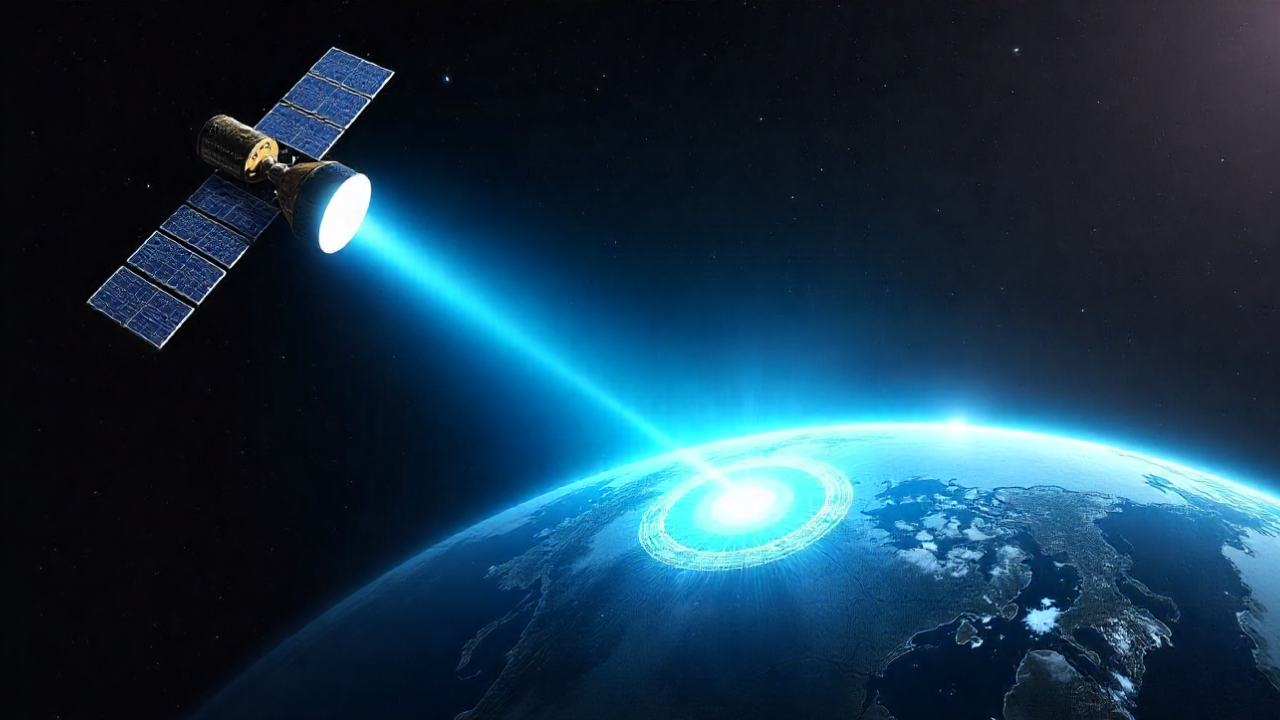
Japan is moving toward a technology straight out of science fiction: solar power harvested in space and beamed to Earth. After decades of research and incremental advances, engineers are preparing demonstration systems that could prove satellites can capture continuous sunlight in orbit and transmit it safely to receivers on the ground — opening the possibility of stable, 24/7 clean electricity that is not limited by weather or night.
How space solar power works
The basic concept is straightforward but technically demanding. Large solar arrays on satellites collect sunlight without interruptions from night or clouds. The generated electricity is converted into a directed microwave (or laser) beam and sent to a terrestrial receiving station — a rectenna — that converts the incoming energy back into usable electricity and feeds it into the grid. Because orbital platforms see near-constant sun, their theoretical energy yield per unit area can far exceed ground-based systems.
Japanese teams have focused on combining lightweight photovoltaics, high-efficiency power-conversion electronics, and precise beamforming antennas so a compact satellite can deliver meaningful power while meeting strict safety and regulatory constraints.
Why this could be transformative
Space-based solar eliminates two of solar power’s main limitations on Earth: night and clouds. For countries with limited land, variable weather, or high demand peaks, space solar offers a path to predictable, dispatchable renewable power. If scaled economically, the technology could:
- Provide continuous base-load or peak power without fossil fuels.
- Lower the land footprint compared with large terrestrial solar farms.
- Supply remote islands, disaster recovery sites or high-demand urban centers through dedicated links.
Major technical and practical challenges
Turning a prototype into a global energy source requires solving several hard problems:
- Launch and construction costs: Building, launching and assembling very large solar platforms remains expensive, though falling launch costs and on-orbit manufacturing could help.
- Transmission efficiency and safety: Converting electricity to microwaves (or infrared/laser), transmitting it across space, and reconverting it on Earth must be highly efficient. Beams must be tightly controlled so they pose no risk to aircraft, wildlife or people. Regulatory approval and robust fail-safe systems are essential.
- Space logistics and reliability: Satellites must survive radiation, micrometeorites and debris, and be serviceable or replaceable over decades of operation.
- Grid integration and economics: Receiving stations need land and transmission links; utilities must adapt to receive and distribute a new, concentrated power source. The overall cost per kilowatt-hour must be competitive with terrestrial renewables plus storage.
- International governance: Cross-border power transmission, frequency allocation and environmental assessments require global cooperation and clear standards.
Environmental and societal considerations
Proponents highlight major climate benefits: continuous, carbon-free electricity could reduce reliance on fossil fuels and storage-heavy grid designs. Yet the technology also raises questions around land use for ground stations, electromagnetic exposure standards, and the environmental footprint of manufacturing and launching large orbital platforms. Meaningful public engagement and independent safety reviews will be critical.
The roadmap and next steps
Japan’s work represents a proof-of-concept phase: engineering demonstrations, small-scale power beaming tests and stepwise scale-up of hardware and control systems. The near-term goal is demonstration flights and ground-to-space power tests that validate efficiency, beam control and safety systems. If those succeed, larger prototype arrays and dedicated receiving stations would follow — a process likely to take years, if not decades, before commercial-scale deployments become viable.
Bottom line
Space-based solar power is an ambitious complement to Earth-based renewables. Japan’s push to demonstrate on-orbit solar harvesting and safe power beaming is an important milestone that could, over the long term, add a powerful new tool to the decarbonization toolbox. The promise is huge — continuous, weather-independent solar energy — but so are the engineering, cost and regulatory hurdles. Success will depend on steady technological progress, transparent safety testing and international collaboration to govern a new frontier of clean power.
Nature — explainer on feasibility and top challenges for SBSP
Place after the section that lists the main hurdles (cost, transmission, governance).
Nature
Anchor text: Nature: Could solar panels in space supply Earth with clean energy?


 By
By

 www.binance.info registrera dig says: